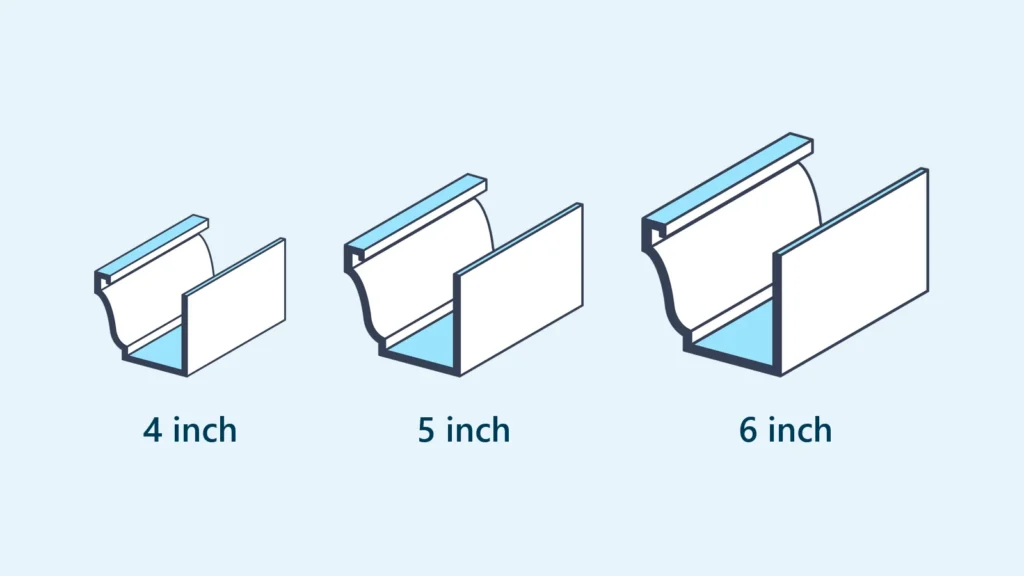
Yes. Supply yards and hardware stores sell 4 inch gutters today, mostly for sheds, garages and small porch roofs.
On a full house in Chicagoland, most installers fit 5 or 6 inch instead. Our team does too, and this post explains why.
Can you buy 4 inch gutters today?
You can. Retail listings show 4 inch K style gutters in aluminum, sold by the foot and formed from a coil. Galvanized steel versions come in 10 foot lengths, with end caps and corners to match.
Finding the size is easy. Deciding if it fits your house takes a closer look at the roof.
What buildings use 4 inch gutters?
Small roofs are the usual home for them. A detached garage, a shed, a carport or a covered porch has a small roof area. A 4 inch trough can take the water that roof sends down.
Some homeowners also put them on a bay window roof or a small entry overhang. Those roofs are only a few feet wide.
If a gutter on your house looks thin next to the ones on your block, measure it. You may have 4 inch gutters on the main roof.
How do you measure the size of a gutter?
Set a ladder on firm, level ground and climb to the gutter. Measure across the open top, from the front lip to the back wall.
That number is the size. A trough that reads about 4 inches across is a 4 inch gutter.
Check the downspout while you are up there. A small gutter often drains into a small downspout, and both limit how fast water leaves the roof.
Why do most installers skip the 4 inch size on a house?
A roof catches every drop of rain that lands on it. All of that water flows down to the edge and into the gutter.
A house roof is many times larger than a shed roof. So the gutter on a house has to take far more water each minute.
Chicago summer storms can drop a lot of rain in a short time. A small trough fills faster than its downspout can drain it, and then the water spills.
Steep roofs add to the problem. Water moves faster down a steep pitch, and it can shoot past a narrow gutter.
When a gutter spills, the water goes one of two places. It pours over the front lip onto the ground beside your foundation. Or it slips over the back edge, behind the gutter, onto the wood at the roof edge.
Both spills cost money later. A wet foundation can lead to a damp basement, and wet wood behind a gutter can rot.
What size do we fit on Chicagoland homes?
Our crews fit two sizes. 6 inch oversized is our default, and 5 inch is available.
We form every gutter on site from a coil of .032 inch aluminum. A gutter machine shapes it, and we cut each piece to the length of your roof edge.
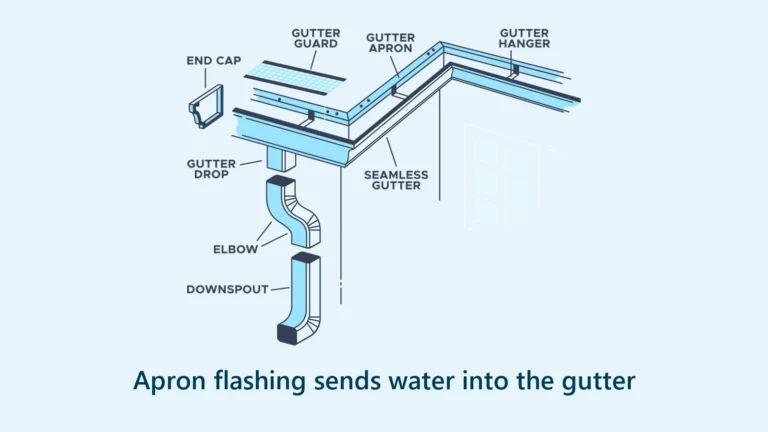
Each gutter hangs on QuickScrew hangers spaced every 24 inches. Apron flashing goes on every install, and GeoCel sealant closes the corners and end caps.
Every job comes with a lifetime warranty on materials and workmanship.
Choosing between the two sizes depends on your roof. Our guide to 5 inch vs 6 inch gutters walks through that choice.
Is a 4 inch gutter on your house a problem?
It can be, if you see the signs. Look for them after the next hard rain.
Water spills over the front of the gutter, or dark streaks show on the siding below. A trench forms in the mulch under the roof edge.
Up at the roof edge, the paint on the wood behind the gutter peels. The wood itself may feel soft when you press it.
Any one of these means the gutter is not taking all of the water. A bigger trough is often the fix.
A 4 inch gutter on a garage or shed can be fine for years. On the main roof of a house, it is worth a closer look.
What should you do next?
Walk around your house during the next storm and watch where the water goes. Take a photo of anything that spills.
Then give us a call. We can measure your roof and your gutters and show you what size fits.
Read how we form, hang and seal each gutter on our seamless gutter installation page. Or call (866) 488-7776 for a free estimate anywhere in Chicagoland.