

Most gutter problems show up as one of seven things. They are clogs, spilling in heavy rain, sagging, pulling away, leaking seams, standing water and winter ice.
Some are a quick fix. Others mean the gutter is near the end of its life. Here is how to tell which is which on your own house.
1. Why are my gutters clogged?
Leaves, maple seeds and shingle grit pack into the trough and the top of the downspout. Once the outlet plugs, water backs up and spills over the front.
A clog says nothing bad about the gutter itself. Pull the debris out and it drains again.
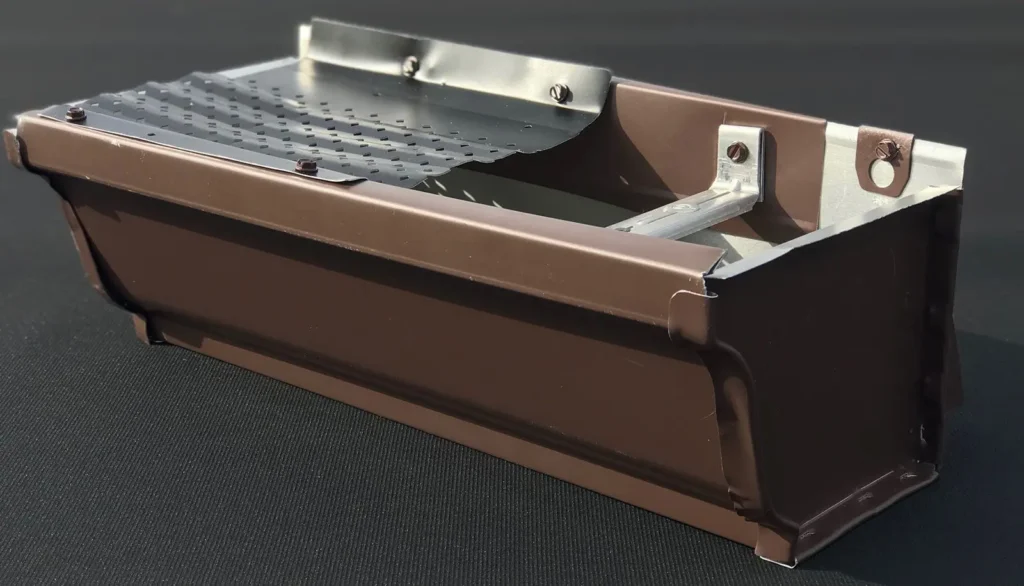
If it comes back every fall, stop it at the edge of the roof. That is the job gutter guards do, and the ones we fit are Raindrop.
2. Why do my gutters overflow when they are empty?
A clear gutter that spills in a hard rain is too small for the roof above it. Either the trough is too narrow or there are too few downspouts.
Most houses get 5 inch gutters because that size comes standard, whatever the size of the roof above them.
Sometimes one more downspout is enough, so check the downspout size against the gutter first. If the trough itself is too small, it has to come off. We fit 6 inch as our standard.
3. What does a sagging gutter mean?
The hangers are letting go. Older gutters often hang on long spikes driven through the trough into the wood, and wet snow works them loose one winter at a time.
A short sag with sound wood behind it can be rehung. A sag along the whole length usually means the hangers and the board behind them are both worn out.
Our hangers are QuickScrew, set every 24 inches and screwed into the fascia board.
4. Why is my gutter pulling away from the house?
Something behind it has gone soft. Water that gets behind the gutter soaks the fascia board, and a rotted board cannot grip a screw.
Look for paint peeling in a flat band just under the gutter. That stain shows water has been reaching the wood for a while.
New gutters cannot go onto soft wood. We replace the soffit and fascia as one job with the gutters. We also fit gutter apron flashing on every install, so water cannot get back there.
5. Why do my gutter seams leak?
Sectional gutters come in short lengths that are joined together on the house. Each joint is sealed, and the sealant cracks after enough freezing and thawing.
A drip at one corner can often be resealed. Drips at joint after joint along one side of the house mean the sealant is failing everywhere at once.
Our seamless gutters are formed on site in one piece for each side of the house. The only joints are at the corners and the downspouts, and we seal those with GeoCel.
6. Why is there standing water in my gutters?
The slope is gone. A gutter has to fall a little toward each downspout, and settling or loose hangers can flatten it or tip it the wrong way.
Look in the trough on a dry day. Water in it with no rain means it has nowhere to go.
This one is often a repitch instead of a replacement, as long as the metal and the wood behind it are sound.
7. What do icicles and ice dams say about my gutters?
A row of heavy icicles along the gutter means water is freezing at the roof edge instead of draining away. A downspout elbow packed with ice does the same thing.
Ice is heavy, and a gutter full of it pulls on every hanger. After a hard winter, look for new sags and for gaps where the gutter meets a corner.
Why Chicago houses see all seven
Our winters swing above and below freezing again and again. Every swing moves the metal, and every joint moves with it.
Wet snow loads the gutters all winter, and summer storms drop a lot of rain in a short time. Many older blocks also have big trees that shed leaves and seeds straight onto the roof.
Which problems mean the gutters are past saving?
A clog, one leaking corner or a flat section can usually be fixed. These are the signs that a fix will not last:
- The fascia board behind the gutter is soft or rotted.
- The gutter sags or leaks along most of its length.
- The trough is too small for the roof, or the metal is split, rusted through or badly bent.
When three or four of these show up on the same house, a gutter replacement usually costs less than another season of patching. Here is how we decide whether to repair or replace gutters on a house like yours.
What to do next
Walk around the house during the next hard rain. Note where water comes over the edge, where it drips from a joint and where it lands.
Then call us at (866) 488-7776. We install and replace gutters, and we do not take repair work. If your gutters have more years in them, we will tell you so.
Every system we install comes with a lifetime warranty on the gutters and on the workmanship.


