

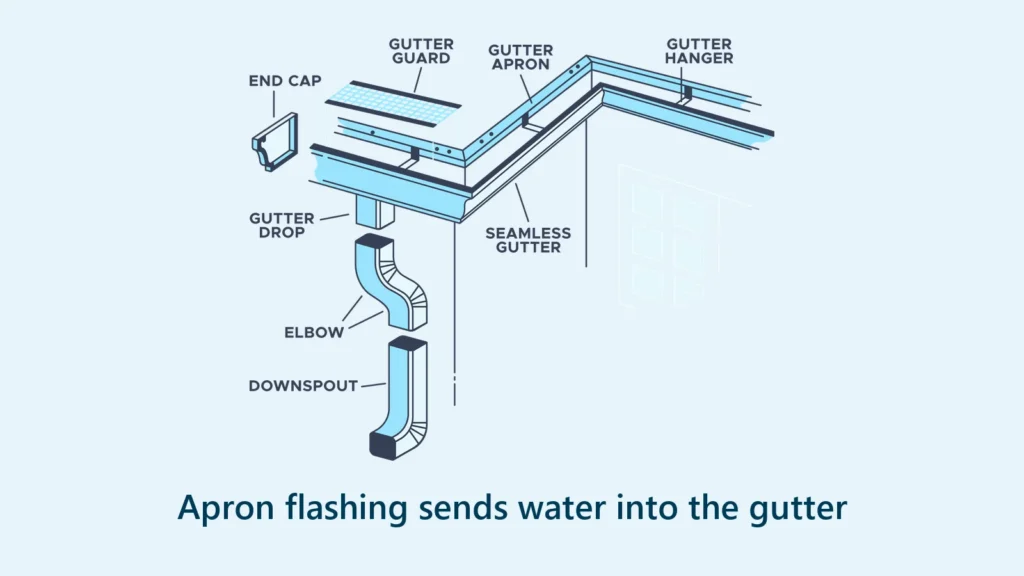
Water is getting behind the gutter. It drips down the back of the trough onto the wood at the roof edge, and that wood never gets a chance to dry out.
The usual causes are missing apron flashing, overflow, the wrong pitch, or hangers that let the gutter pull away from the house.
What is the wood behind a gutter?
The board a gutter hangs on is the fascia. It is a long board fixed to the ends of the roof rafters, right under the shingle edge.
Under the fascia is the soffit, the flat panel that closes off the underside of the roof overhang. Rot on the fascia often spreads to the soffit and to the roof deck above it.
What causes rotting wood behind gutters?
Water gets behind a gutter in five common ways. One house can have two or three of them at once.
No apron flashing. Apron flashing is a bent metal strip that tucks under the shingles and laps over the back of the gutter. Without it, rain can curl under the shingle edge and drip straight down the fascia.
Overflow. A gutter that is too small for the roof, or one packed with leaves, fills up in a storm. The water spills over the back edge as easily as the front.
The wrong pitch. A gutter needs a slight slope toward each downspout. If it slopes the wrong way or sags in the middle, water pools in one spot and soaks the board behind it.
Loose hangers. Old gutters often hang on long nails driven through the gutter into the fascia. As the nails back out, the gutter tips forward and opens a gap at the back.
Leaking joints. Store gutters come in short sections joined with caulk. When the caulk cracks, each joint drips onto the same few inches of wood.
How can you spot rot from the ground?
Start with a slow walk around the house on a dry day. Look up at the roof edge and the gutters.
Peeling or bubbling paint on the fascia is the first sign. Dark streaks or stains on the board below the gutter mean water is coming over or behind it.
A gutter that tips forward, sags or pulls away from the house is a warning too. The wood behind it may no longer grip the fasteners.
Check the soffit for stains, holes or loose panels. Birds, squirrels and insects move into soft wood at the roof edge.
How do you check the wood up close?
Set a ladder on firm ground and press the fascia with a screwdriver tip. Sound wood resists the tip.
Rotted wood feels soft or spongy, and the tip sinks in. It may also crumble or come away in damp strings.
Test a few spots along each wall, especially near corners and downspouts. Those are the places where water collects first.
Why does a Chicago winter make it worse?
Snow on the roof melts during the day and freezes again at night. That cycle sends water to the roof edge for weeks at a time.
Ice can build up in the gutter and push meltwater back under the shingles. From there it drips down behind the gutter and onto the fascia.
Water that soaks into a small crack in the paint freezes and expands. Each freeze opens the crack a little wider, and more water gets in.
By spring, a small soft spot can turn into a long stretch of rotted board.
Why can’t a gutter go on soft wood?
A gutter hangs from the fascia, and every hanger is screwed into that board. Soft wood cannot grip a screw.
A full gutter is heavy. Add wet leaves, snow or ice and the load climbs fast.
On rotted wood, the hangers pull out under that weight. The gutter sags, tips or falls, and the water goes right back behind it.
So the rotted wood comes off first. A fresh board goes up, and then the gutter goes on.
What should you do if you find soft wood?
Find the source of the water before anything else. A painted patch over rotted wood hides the problem for a season and then fails.
Look at the gutter above the soft spot. Check for overflow, a bad pitch, loose hangers or a gap at the back.
If the gutters are old or the rot is spread out, plan for both jobs at once. The gutter has to come down anyway to reach the wood behind it.
How do we handle rotted wood with a gutter install?
When we install gutters, we replace rotted boards at the roof edge in the same job. You get one crew, and one visit.
Every gutter we hang gets apron flashing, so rain drops into the trough and not down the board. QuickScrew hangers go in every 24 inches and bite into fresh, solid wood.
Read about our soffit and fascia work. Or call (866) 488-7776 for a free estimate anywhere in Chicagoland.


