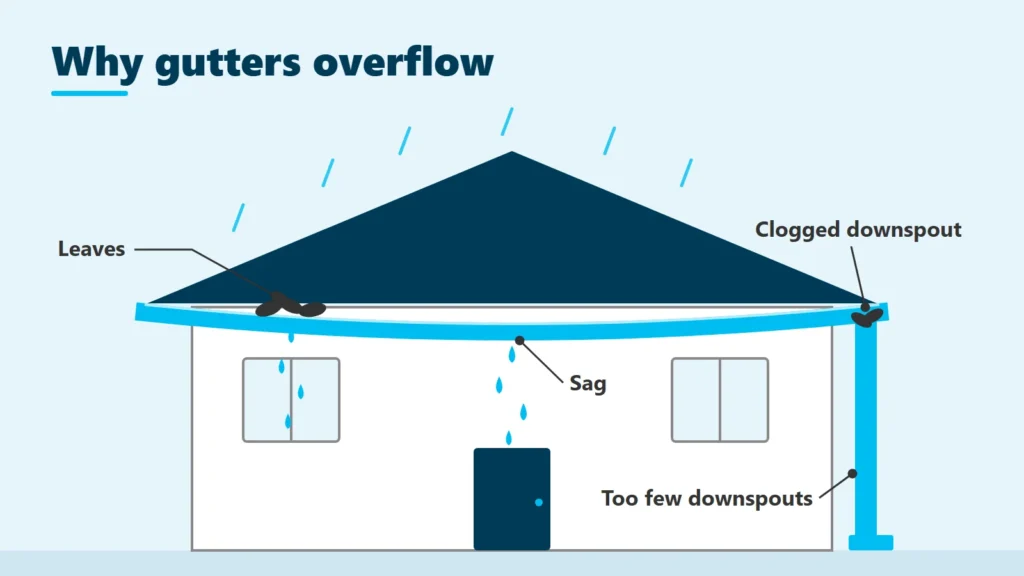
Gutters overflow when rain pours in faster than the downspouts can drain it. Most of the time the cause is a clog, too few downspouts, a gutter that is too small, or the wrong slope.
Overflow is one of the common gutter problems homeowners face around Chicagoland. This guide covers each cause, how to spot it from the ground, and what to do next.
What causes gutters to overflow?
Water spills over the edge when it has nowhere else to go. These are the seven common causes, and one house can have more than one.
A clogged gutter. Leaves, twigs, maple seeds and shingle grit pile up in the trough. They form a dam, and water backs up behind it until it spills over the front.
A clogged downspout. The elbow at the top of a downspout catches leaves first. Once it plugs, the gutter fills up and spills near that corner of the house.
Too few downspouts. One downspout on a long gutter has to drain a big piece of roof. In a hard rain, water reaches it faster than it can drain.
A gutter that is too small. A big or steep roof sends more water than a small gutter can take. Our guide to 5 inch vs 6 inch gutters explains how width changes what a gutter can handle.
The wrong slope. A gutter needs a slight drop toward each downspout. A common guide is about a quarter inch of drop for every 10 feet of gutter.
A sag. Old hangers work loose over time and let a section dip. Water collects in that low spot and pours over the edge.
Ice. In winter, meltwater can freeze inside the gutter and the downspout. The next melt has no way out, so it goes over the side.
Which part of your gutter is spilling over?
Watch your gutters during the next good rain. Stand on the ground, well back from the roof edge, and look for the spot where water comes over.
Near a downspout. The downspout or its top elbow is likely clogged.
In the middle of a long gutter. Look for a sag, or a slope that tips the wrong way.
At an inside corner. Two roof slopes meet here, so the water comes down fast. It can shoot right past the front of the gutter.
All along the gutter, even when it is clean. The gutter may be too small, or the house may need more downspouts.
Behind the gutter. Water is getting between the gutter and the house, often at the shingle edge.
How many downspouts do I need?
A common guide is one downspout for every 30 to 40 feet of gutter. Every separate gutter on the house needs at least one.
Roof size counts too. Another common guide is one downspout for every 600 to 800 square feet of roof, and a steep roof may need more.
On a gutter longer than about 40 feet, installers often put a downspout at each end. The high point goes in the middle, and the gutter slopes down both ways.
To check your house, measure each gutter and count its downspouts. If one downspout drains 50 feet of gutter or more, that stretch likely needs a second one.
How big each downspout should be is its own question. Our guide on downspout size covers which one fits a 5 or 6 inch gutter.
How can you check your gutters yourself?
You can find most causes with a garden hose and a ladder. Set the ladder on firm, level ground, and have a second person steady it.
Look for standing water. Check the gutter two days after a rain. Pooled water points to a sag or a bad slope.
Test the flow with a hose. Put a garden hose in the far end of the gutter and turn it on. Watch the water move to the downspout and out the bottom.
Flush a slow downspout. If water backs up at the downspout, push the hose in from the top and flush it out.
Clear the leaves. Scoop leaves out of the gutter by hand, with gloves on.
Look for dips and gaps. From the ground, look along the gutter for low spots, gaps and loose hangers.
If your roof is high or steep, skip the ladder. You can learn a lot by watching from the yard in the next storm.
Why do Chicago gutters overflow so often?
Chicagoland trees fill gutters twice a year. Maple seeds come down in spring, and oak and maple leaves come down in fall.
Our summer storms can drop a lot of rain in a short time. A gutter with a small clog may handle a light rain fine and then spill over in a downpour.
Winter adds ice. Snow on the roof melts by day and freezes again at night, and that ice can plug the gutter and the downspout.
What can overflow do to your house?
Water that spills over lands right next to the foundation. It can soak the soil there, wash out flower beds and seep into a basement.
Overflow also splashes the siding. Water that comes over the back of the gutter soaks the wood at the roof edge, and that wood can rot.
How do gutter guards help stop overflow?
A gutter guard covers the top of the gutter. Rain gets in, and the guard blocks most leaves and seeds.
With less debris inside, the gutter and downspouts can drain the way they should. That cuts down on clogs, the most common cause of overflow.
Guards do not fix a gutter that is too small or sags. If your gutters are old or dip in a few spots, new gutters may be the better step.
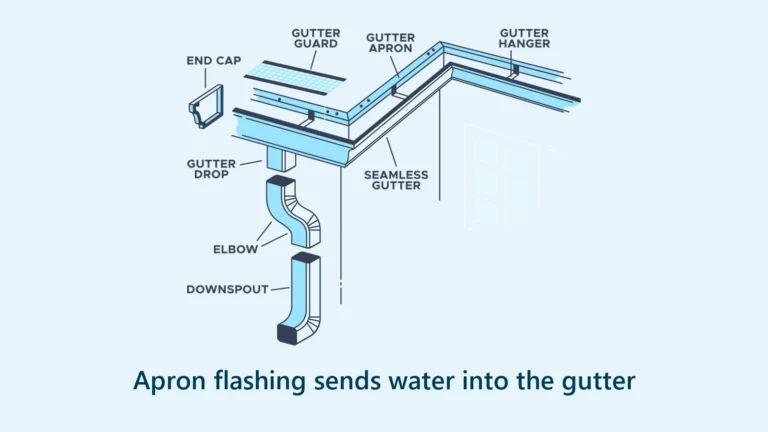
When we install gutters, 6 inch is our default size, and 5 inch is also available. QuickScrew hangers go in every 24 inches, and every install gets gutter apron flashing at the shingle edge.
Our team installs Raindrop gutter guards across Chicagoland. Read about the gutter guards we install, or call (866) 488-7776 for a free estimate.