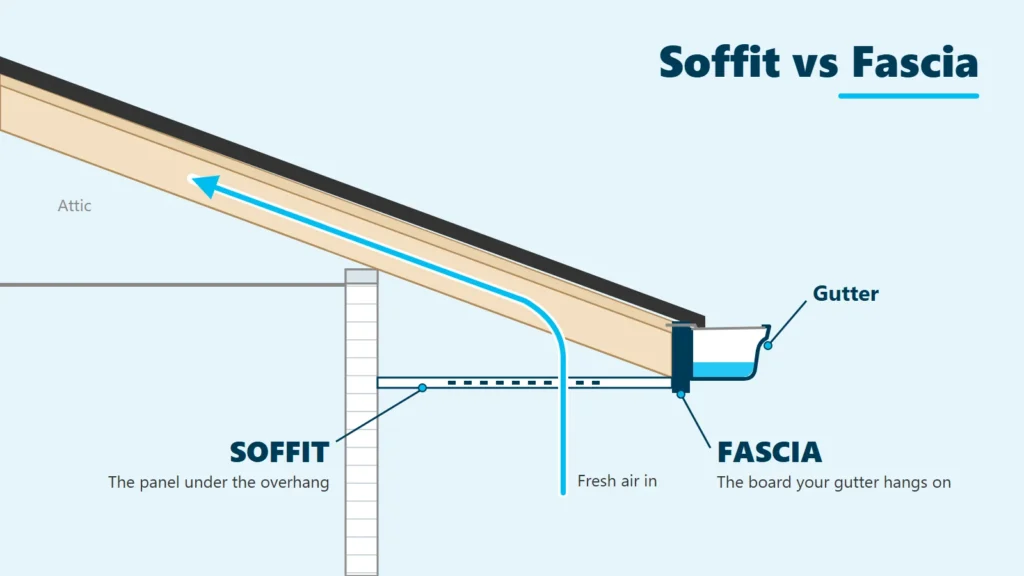
The fascia is the long board that faces out along the edge of your roof, and your gutters hang on it. The soffit is the panel under the roof overhang that faces down toward the ground.
Both boards close off the roof edge where the rafters end. Below, our team explains what each one does, how to tell them apart, and why they are often replaced together with the gutters.
What is a soffit?
A soffit is the underside of the roof overhang. Stand close to your house, look straight up at the edge of the roof, and the flat surface you see is the soffit.
It spans the gap between the outside wall and the fascia. Behind it are the rafter tails, the ends of the roof beams that stick out past the wall.
The word comes from the Italian “soffitto,” which means ceiling. That fits, since a soffit works like a small ceiling for the outside of your home.
Many soffits have rows of small holes or slots. These vented soffits let outside air into the attic. A solid soffit has no openings, so it closes off the overhang and lets no air through.
What is fascia?
Fascia is the flat board on the front edge of the roof, right under the shingles. It faces out toward the street or the yard.
On many homes, a second board called the subfascia is nailed to the cut ends of the rafters first. The fascia goes on the front of it.
This board has two jobs. It covers the rafter ends from rain and snow, and it gives your gutters something to hang on. Every gutter hanger on your house is screwed into it.
What is soffit and fascia on a house?
Soffit and fascia are the two parts that finish off the edge of the roof. The fascia forms the front face, and the soffit closes the bottom between that board and your wall.
Together they make a box around the rafter ends. That box guards the wood from weather and blocks birds, squirrels and bugs from getting into the attic.
Your gutter hangs on the outside of that box. It catches the water that comes off the shingles.
Soffit vs fascia: how do you tell them apart?
Walk out into the yard and look at the roof edge. The fascia faces you, as the upright strip right behind the gutter.
Now stand close to the wall and look up. That surface facing the ground is the soffit, and rows of small holes or slots are almost always on it.
Gutters hang on the fascia and are never fixed to the soffit. From a ladder, the corner where the two meet shows both at once.
What are soffit and fascia made of?
Soffits are most often aluminum, vinyl or wood. Fascia is often wood, PVC or fiber-cement board.
On many homes, a wood fascia is covered with a thin aluminum wrap. The wrap looks clean from the street. The wood under it is out of sight, so damage there can be hard to spot until the gutter comes off.
Why do soffit vents help in a Chicago winter?
In winter, warm air from the house drifts up into the attic. A warm attic melts the snow on the roof from below.
That meltwater flows down to the cold roof edge and freezes again. The ridge of ice it builds over the gutter is called an ice dam.
Soffit vents let cold outside air in at the eaves. From there the air moves up under the roof and out through vents near the peak. A cold roof melts less snow, and fewer ice dams form.
Insulation pushed into the eaves can block that airflow. ENERGY STAR advises homeowners not to cover soffit vents with insulation.
A Chicago winter can leave snow on a roof for weeks at a time. That is when soffit vents do their most useful work.
Why are soffit and fascia replaced with the gutters?
Your gutters hang on the fascia. To put up a new fascia, the gutter on it has to come down first.
That makes the gutter job the best time to look at the wood. Rot often hides behind a gutter, and you only see it once the gutter is off.
A new gutter needs solid wood behind it. Each hanger screw has to bite into sound fascia to bear the weight of water, snow and ice.
Rot in the fascia often spreads to the soffit right next to it. So when the old gutters come down, we replace worn soffit and fascia in the same job. The new boards go up first, and then the new gutter goes on fresh wood.
If the boards wait until later, the new gutters have to come down again to reach them.
Already seeing peeling paint or soft spots? Our post on rotting wood behind gutters walks through the causes and how to check the wood.
How does our team handle soffit and fascia?
Soffit and fascia is one of the services we offer, along with new gutters and gutter guards. When we install gutters, we replace the worn boards at the roof edge before the new gutter goes up.
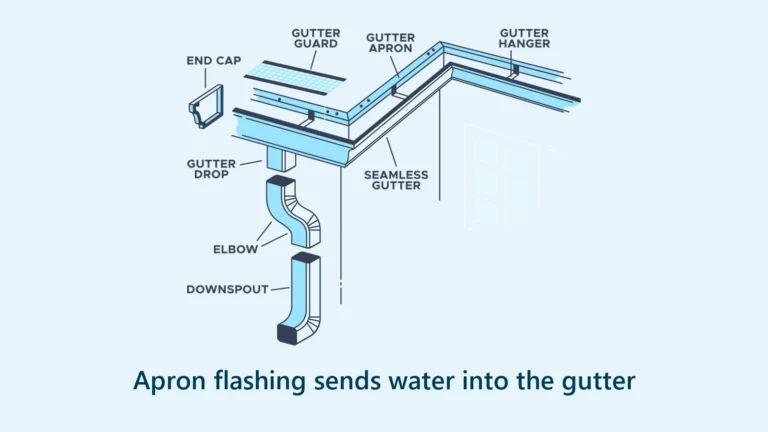
Every gutter we hang gets apron flashing, which sends rain into the gutter and away from the fascia. Our QuickScrew hangers go in every 24 inches and screw into fresh, solid wood.
See how we handle soffit and fascia with new gutters. Or call (866) 488-7776 for a free estimate anywhere in Chicagoland.