Seamless aluminum gutters last about 20 to 30 years in the Chicago area. The aluminum itself outlives every part attached to it.
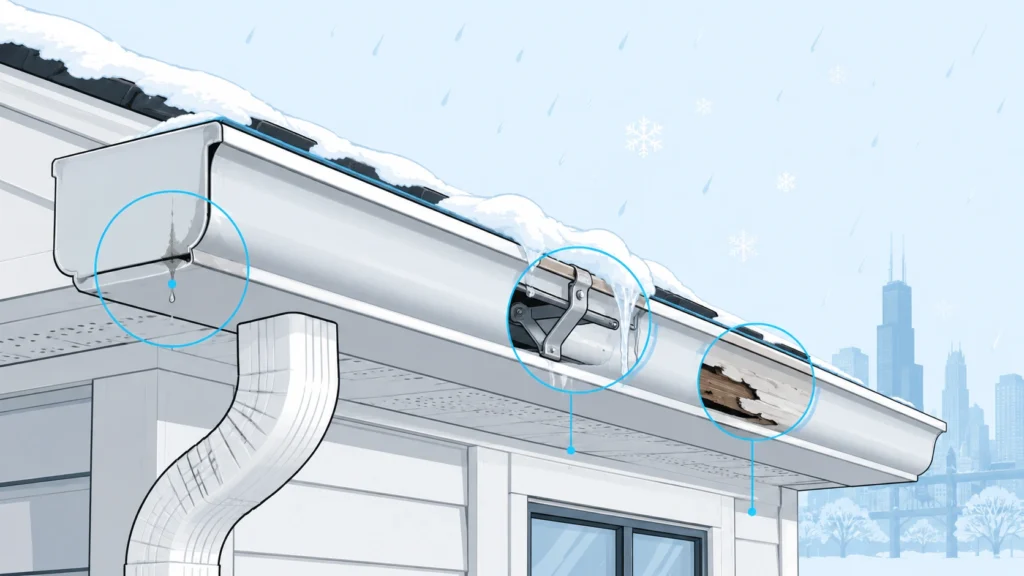
What fails first is the sealant at the corners, then the hangers, then the fascia board behind the trough. A system replaced at year 22 is usually replaced because of those three things, not because the metal wore out.
What wears out first?
Corner sealant goes first. Every joint at an inside or outside corner flexes as the metal warms and cools. A cheap sealant lets go after a handful of Chicago winters.
Hangers go second. Spikes and thin brackets loosen from the fascia under the weight of wet snow, and once a section sags the water pools instead of draining.
The fascia board goes third. That one is the expensive failure, because rotted wood means carpentry before anyone can hang new gutters.
Why Chicago is harder on gutters than most places
Our winters swing above and below freezing many times between November and March. Each swing expands the aluminum and then shrinks it, and every joint in the system moves with it.
Wet snow adds weight the trough was never asked to take in October. A 40 foot section loaded with ice and slush pulls on hangers set 36 inches apart.
Summer does its own damage. Storms that drop an inch of rain in an hour push water over the front lip, and that water lands at the foundation.
Does gutter size change the lifespan?
A 6 inch trough drains more water per minute than a 5 inch trough, so it spends less of its life overflowing. Less overflow means less water against the fascia and less rot behind the gutter.
Thickness does the same job for dents. Thinner coil creases when a ladder leans on it, and a crease at the front lip changes where the water goes. We use .032 inch aluminum for that reason.
Hanger spacing decides how the system ages under snow. Ours go in every 24 inches instead of the 36 inches you find on a budget install.
How to tell yours are near the end
Look at the corners after a rain. A dark stain below a corner joint means the sealant has failed.
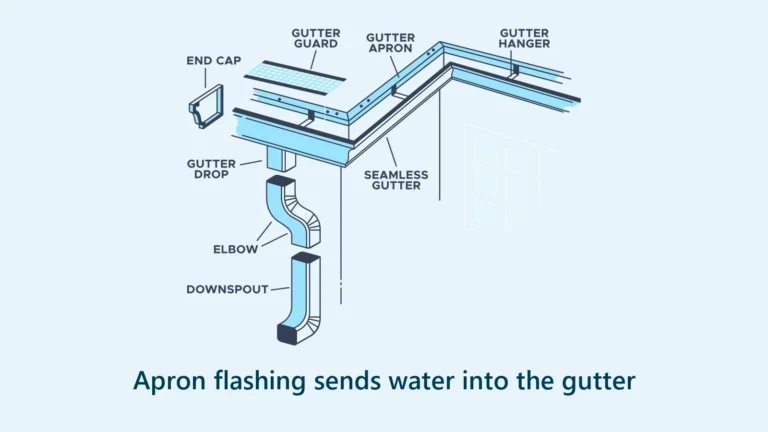
Check the fascia from the ground with binoculars. Paint peeling in a horizontal band behind the gutter means water gets past the back edge. On most of those houses nobody fitted gutter apron flashing.
Push up gently on the front lip at the middle of a long section. Movement of more than half an inch means the hangers have given up.
Pooled water in the trough on a dry day means the slope is gone. That one is often a repitch instead of a replacement.
Does a lifetime warranty change the answer?
It changes who pays for the failures above. Our installs come with a lifetime warranty on the gutters and on the workmanship, for as long as you own the house.
That covers the sealant, the hangers and the seams. It does not cover a tree limb through the trough or damage from another contractor working on your roof.
The warranty is the reason we fit gutter apron flashing on every job when many Chicago companies leave it off. Water that gets behind the trough rots the fascia, and we would be the ones going back to fix it.
What to do next
If your gutters are past 20 years and the corners are staining, get a written estimate before the first hard freeze. Autumn installs beat winter ones because the sealant cures properly above 40 degrees. If a new roof is coming too, read about replacing gutters with a new roof first. The roof goes on before the gutters.
Read what is behind our lifetime gutter warranty. Or call (866) 488-7776 and we will look at what you have, then tell you whether it needs replacing this year.