

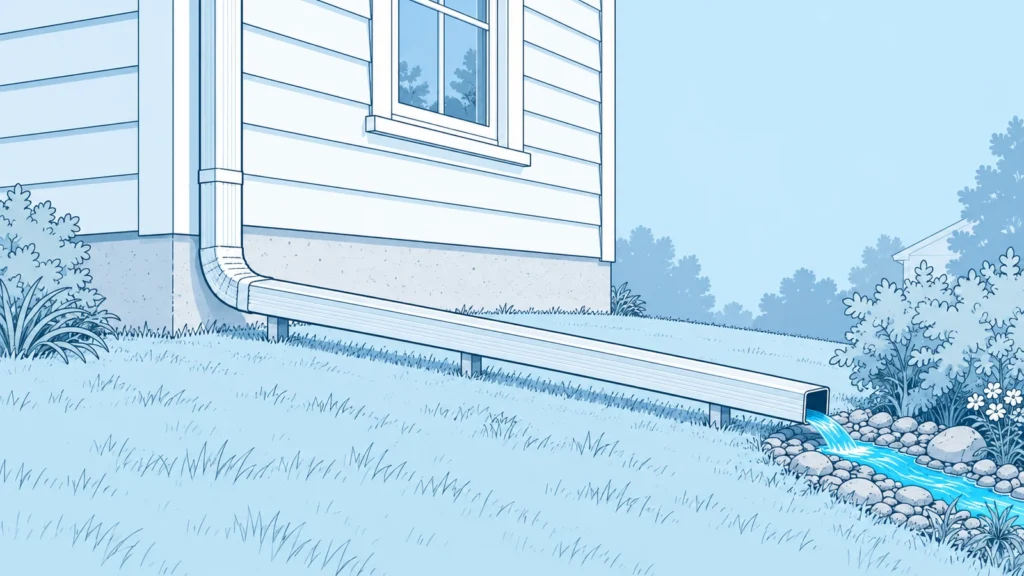
At least four to six feet from the foundation, onto ground that slopes away from the house.
That is the whole answer. The reason it gets ignored is simple. Most downspouts end in an elbow a few inches off the wall, and nobody thinks about the last three feet.
How far from the house should a downspout drain?
Four feet is the minimum most builders work to. Six feet is better, and ten feet is better again on a house with a basement.
The number that decides it is your grade. Water needs somewhere downhill to go once it lands. A long extension onto flat ground does less good than a short one onto a slope.
If the ground falls back toward the house, the extension has to reach past the point where it levels out.
What a downspout extension does
An extension moves the discharge point away from the wall. Nothing else about the gutter system changes.
It is the cheapest part of the whole setup and the part most likely to be missing. A full system can be sized right, pitched right and sealed right, and pour every gallon straight down beside the footing.
The four ways people extend a downspout
A fixed aluminum or vinyl extension. A straight length clipped to the bottom elbow. Simple, cheap, and easy to knock loose with a mower.
A hinged or flip up extension. The same idea on a hinge, so it lifts out of the way for mowing. It only works if somebody puts it back down.
A roll out sleeve. A flat tube that unrolls under water pressure and rolls back when the rain stops. Good for a spot where a permanent pipe is in the way.
A buried line to daylight. A pipe under the lawn that surfaces somewhere lower on the property. It is the tidiest answer and the most expensive, and it needs a fall the whole way.
A splash block is not an extension
A splash block is a tray that breaks the force of the water so it does not dig a hole. It moves the discharge point by about a foot.
On a house with a basement, a foot is not enough. Splash blocks and extensions do two different jobs, and a splash block at the end of an extension is a reasonable pairing.
What happens when water lands at the foundation
One downspout on an average Chicago roof can deliver hundreds of gallons in a single storm. All of it goes into the same square yard of soil every time it rains.
That soil swells, presses on the wall, and drains back toward the footing. Over a few seasons it is how a dry basement becomes a damp one.
The signs show up outside first. A trench worn into the mulch, a stripe of splashed dirt up the siding, moss on the wall below the elbow.
Why Chicago makes it worse
Much of Chicagoland has heavy clay soil. Clay drains slowly, so water pooled beside the house has nowhere to go but sideways, into the wall.
Winter adds the second half of the problem. Water discharged next to the foundation freezes there, and frozen soil expands against whatever it is touching.
A buried line has its own winter rule. If it does not fall the whole way to its outlet, the low spot fills and freezes. The whole line then backs up to the elbow.
How to check your own downspouts
Walk the house during the next hard rain. You want the water landing well clear of the wall and moving away from it.
Look for the three failures that show up most. An extension knocked loose and left in the grass, or one that ends on flat ground. A buried outlet silted over and no longer taking water.
Then check the top of the system while you are out there. If water is coming over the front lip of the gutter, the problem is the size of the downspout, not where it drains.
The order to fix things in
Sizing first, then discharge. A correctly placed extension on an undersized pipe just moves an overflow problem four feet further out.
Get the trough and the pipe right, then decide where the water goes. Our standard is 6 inch oversized aluminum with 3×4 downspouts. That pairing empties fast enough that the extension becomes the thing deciding where water ends up.
Read the full spec on our seamless gutters page. Or call us at (866) 488-7776 and we will look at your downspouts and your grade together, for free.


